
Can you imagine a color you’ve never seen before?
How many variations of a color can you imagine?
Colors are fascinating, aren’t they? If you think about it, the concept of color raises many interesting questions.
Are there many other colors in this world that we cannot perceive?
Of course. We realized that when we studied the electromagnetic spectrum in school. We’re missing out on so much on account of limited perception.
Perceiving Colors
At its core, the way our eyes perceive colors involves a complex process. When light enters our eyes, it is absorbed by photoreceptors in the retina, which include rods that detect light and dark, and cones that detect color.
Humans are trichromats, meaning we have three types of cone receptors: red, green, and blue. Some individuals, due to a genetic mutation, have four cone receptors (tetrachromats). The combination of these cones allows us to see a million different colors.
The signals from these photoreceptors are then transmitted to the brain through the optic nerve, which relays the information to the visual cortex in the occipital lobe. The visual cortex interprets visual data, including color.
Different regions of the visual cortex respond to different colors, working together in a complex network to help us recognize and understand the colors we see.

Color Psychology
So, the brain interprets the color. What happens next?
It’s hard to explain, but colors do evoke psychological responses. Sometimes they tap into deep-seated associations and meanings.
Color psychology is a field that examines how colors affect human behavior and emotions.
It’s interesting how the same color can evoke both positive and negative perceptions. For one person, the color red might remind him of his first gift, a toy car, creating a positive association. For another, it might evoke a negative association, reminding him of a hospital he hated visiting.
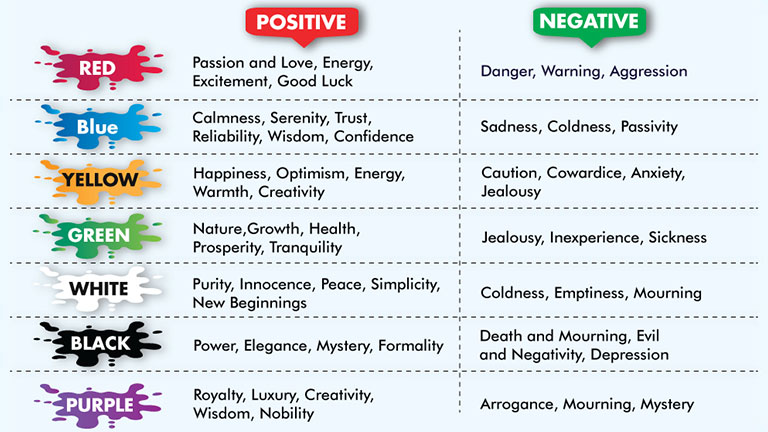
Color in Marketing and Branding
Color psychology is a crucial concept for marketers or anyone working on building a brand.
For instance, if you’re a multinational brand, it’s crucial to understand how colors can be perceived differently by various cultures, ethnicities, and individuals. In one country, black might be associated with elegance and sophistication, while in another, it could be linked to evil or bad luck.
Color impacts consumer behavior.
When Heinz released a green-colored ketchup, sales soared to the highest in the brand’s history. Encouraged by this, they released pink, purple, and orange-colored ketchup, but the response was miserable. The moral of the story? According to William Lidwell, green ketchup worked because green tomatoes exist. Tomatoes in purple? Ugh…
Color increases brand recognition. [University of Loyola, Maryland study]
Brand colors establish brand identity. That’s why the red of Coca-Cola or the green of Starbucks is etched in our minds.
People can make snap judgments about products based on color alone. [Management Decision]
The journal Management Decision published that color is a major contributor to the first impression created by a product in consumers’ minds, thus influencing their decision-making.
Colors have a profound influence on product perception.
In a study, participants were asked to taste three variants of jello—in red, yellow, and blue colors. When reporting their perceptions, red jello was described as sweet like strawberries; yellow was described as sour like lemons; blue was considered disgusting like spoiled food.
Interestingly, all three variants of jello were tasteless. It was the color that influenced their taste perception.
When the same three variants were offered to blindfolded participants, they reported no difference in taste.
Color Twist
Now that we have established that colors evoke emotional responses and influence behavior, we also need to accept that color perception can be quite complicated.
HubSpot conducted a case study to examine the impact of changing a ‘SUBMIT’ button color from green to red on Performable’s website.
A designer might instinctively think green would be more effective for the ‘SUBMIT’ button, symbolizing “go,” whereas red, associated with “stop,” might deter clicks.
But the study revealed the opposite. The red button outperformed the green button by 21%.
So, you never know. One can’t always be right in making assumptions about color perception.
Therefore, it’s essential to validate these assumptions before making decisions and market research can help you with this.
Test First
Market researchers implement several methods to evaluate brand colors:
- Sensory Research
- Packaging Research
- A/B Testing
- Brand Perception Studies
- Neuromarketing
With Market Research, you can fine-tune your brand’s color choices and ensure they effectively resonate with your target audience.
Evaluate them all. The color of your:
- Product: Sensory appeal, category-fit and impact.
- Packaging: First impression, visual appeal and brand-fit.
- Brand Elements: Logos, icons, and other brand identifiers.
- Promotional Material: Color scheme and attractiveness.
- Advertisement: Background and highlights.
- Website Design: The overall look and feel of your online presence, and user experience.